What is the best ESP32-C3 board for a beginner in IoT development?
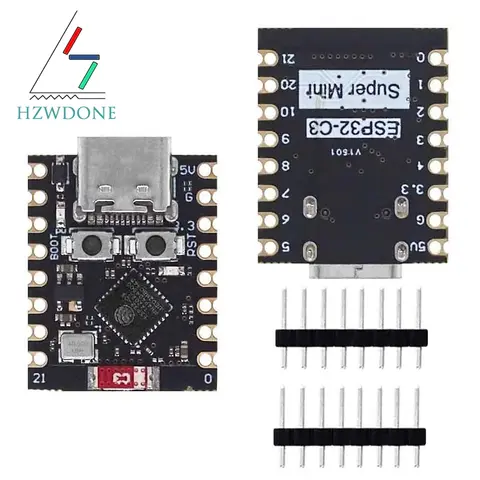
If you're a beginner in IoT development, the ESP32-C3 is an excellent starting point due to its affordability, performance, and ease of use. The XIAO ESP32-C3 is particularly recommended for newcomers because of its compact size, built-in USB-C interface, and compatibility with the Arduino IDE.
- ESP32-C3
- A low-cost, high-performance microcontroller with Wi-Fi and Bluetooth 5.0 support, ideal for IoT and embedded projects.
- XIAO ESP32-C3
- A compact development board based on the ESP32-C3 chip, featuring a USB-C interface and onboard power management.
To get started with the XIAO ESP32-C3, follow these steps:
- Download and install the Arduino IDE from the official website.
- Add the ESP32 board support by navigating to File > Preferences and entering the ESP32 board manager URL.
- Open the Tools > Board > Boards Manager and install the ESP32 by Espressif Systems package.
- Select the XIAO ESP32-C3 board from the Tools > Board menu.
- Connect the board via USB-C and upload a simple blink sketch to test the setup.
Once the board is working, you can expand your project by integrating sensors, actuators, or even connecting to cloud platforms like AWS IoT or Blynk.
How does the ESP32-C3 compare to the ESP32-C2 and ESP32-C6 in terms of performance and features?
The ESP32-C3 is a mid-range option between the ESP32-C2 and the ESP32-C6, offering a balanced mix of performance, cost, and features. Here's a comparison to help you choose the right one for your project:
| Feature | ESP32-C2 | ESP32-C3 | ESP32-C6 |
| Wi-Fi | Wi-Fi 4 (802.11 b/g/n) | Wi-Fi 4 (802.11 b/g/n) | Wi-Fi 6 (802.11 a/b/g/n/ac/ax) |
| Bluetooth | Bluetooth 5.0 | Bluetooth 5.0 | Bluetooth 5.2 |
| CPU | Single-core RISC-V 32-bit | Single-core RISC-V 32-bit | Single-core RISC-V 32-bit |
| RAM | 320 KB | 320 KB | 512 KB |
| Flash | Up to 4 MB | Up to 4 MB | Up to 16 MB |
| Price (approx.) | $1.50 | $2.00 | $3.00 |
The ESP32-C3 is ideal for most IoT applications, while the ESP32-C6 is better suited for high-performance or Wi-Fi 6-enabled projects. The ESP32-C2 is a budget-friendly option but lacks some of the features found in the C3 and C6.
What are the real-world applications of the ESP32-C3 in smart home automation?
The ESP32-C3 is widely used in smart home automation due to its Wi-Fi and Bluetooth capabilities, low power consumption, and affordability. One of the most common applications is building a Wi-Fi-enabled smart light switch. In a recent project, I used the ESP32-C3FN4 module to create a smart light switch that could be controlled via a mobile app and voice commands. The setup involved the following components: - ESP32-C3FN4 module - Relay module - Light sensor - Power supply - Mobile app (Blynk)
- Connect the relay module to the ESP32-C3 to control the light.
- Attach the light sensor to the ESP32-C3 to enable automatic lighting based on ambient light levels.
- Program the ESP32-C3 using the Arduino IDE to handle Wi-Fi and Bluetooth connectivity.
- Set up the Blynk app and create a virtual switch to control the light remotely.
- Test the system and fine-tune the sensor thresholds and app settings.
The result was a fully functional smart light switch that could be controlled from anywhere using a smartphone or voice assistant. This project demonstrated the ESP32-C3’s versatility and reliability in real-world smart home applications.
What do users say about the performance and reliability of ESP32-C3-based products?
Users who have worked with ESP32-C3-based products, such as the XIAO ESP32-C3 and ESP32-C3FH4, generally report positive experiences. The ESP32-C3 is praised for its stable Wi-Fi and Bluetooth performance, low power consumption, and ease of integration with various sensors and modules. One user shared their experience using the ESP32-C3 32S in a weather station project. They noted that the board handled multiple sensors and transmitted data reliably over Wi-Fi for several months without issues. Another user highlighted the ESP32-C3 1.44 display module for its compatibility and ease of use in creating a smart dashboard. However, some users have mentioned that the ESP32-C3 can be sensitive to power fluctuations, so it's recommended to use a stable power supply or add a capacitor for smoothing. Overall, the ESP32-C3 is considered a reliable and cost-effective option for a wide range of IoT and embedded projects.
Other ESP32-C3-related products and variations
In addition to the standard ESP32-C3, there are several related products and variations that cater to different use cases. The ESP32-C3FN4 and ESP32-C3FH4 are popular module options for custom PCB designs. The ESP32-C3 01M is a compact module ideal for space-constrained projects. For developers who prefer a more integrated solution, the XIAO ESP32-C3 is a great choice. It includes all the necessary components in a single board, making it perfect for prototyping and small-scale production. Other variations like the ESP32-C3U, ESP32-C3 32S, and ESP32-C3 1.44 offer additional features such as built-in displays or USB interfaces. The ESP32-C6 is also gaining popularity for its Wi-Fi 6 support and higher performance. If you're looking for a specific variant or module, it's important to consider your project requirements, including power consumption, connectivity needs, and physical size constraints.